
Find more recipes at fussfreeflavours.com
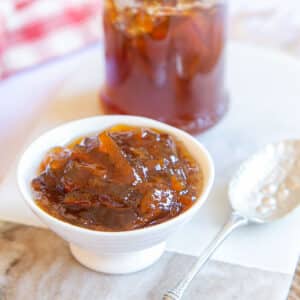
Traditional Seville Orange Marmalade
The classic Seville orange marmalade recipe, made in the traditional way. Delicious on your morning toast or in so many recipes.
Servings: 10 jars (about 3 litres /12 cups in total)
Ingredients
- 1 kg Seville oranges
- 2 lemons - juice only
- 2.5 litres water
- 2 kg sugar
Instructions
- Wash the oranges Then cut in half and juice them. Put the juice in the pan, reserving the pith and pips, and the peels.1 kg Seville oranges
- Place the collected pith and pips onto a square of muslin, or jelly bag. Tie tightly shut.
- Slice the orange peel into narrow strips, and add to the juice.
- Add the water and the bag of pips and pith to the pan.2.5 litres water
- Bring the mixture to a gentle simmer, and cook for 2 hours, uncovered, until the peel is cooked. Check that the peel is soft and will cut easily with a spoon.
- Remove the bag of pips and squeeze the juice from the bag into the pan. One easy way of doing this is by pressing the bag between two plates.
- Prepare clean jam jars. Arrange them on a roasting dish and placing in an oven on a low heat.
- Add the sugar to the pan, together with the lemon juice.2 lemons, 2 kg sugar
- Heat the mixture on a low setting to dissolve the sugar. Keep stirring as it dissolves.
- Once the sugar has dissolved, turn up the heat and bring the mixture to a fast rolling boil. Keep boiling for 5–10 minutes, until you have reached the setting point. Check for a set.
Testing for setting point. Use one or more of these three methods.
- The temperature test. Really accurate electronic jam thermometers are readily available, and not expensive. They are much easier to read than traditional thermometers. Heat the marmalade to the 105°C and once it's that hot it should at at setting point. I always double check and test with a wrinkle test.
- The wrinkle test. Place a couple of side plates in the freezer before you add the sugar. Once the marmalade is boiling, start testing by placing some on the plate. Allow it to cool and when you push your finger through the marmalade, if it's setting you'll see it wrinkle up a little ahead of your finger. This technique takes a bit of practice.
- The flake test. Take a spoonful of marmalade from the pan and turn it vertically to tip it out. If the marmalade runs off quickly and completely it hasn't set. If, however a little remains on the spoon in a sort of wide drip that doesn't fall, then the marmalade is ready. Again, this works best with some practice.
Once setting point has been reached
- Let the marmalade cool for about 10 minutes, and then transfer to the warmed jam jars. Fit the lids and allow to cool completely.
Notes
Storage
Store marmalade in a cool dark cupboard. It will last for years unopened. Once opened, use within a few weeks. Don't keep marmalade in the fridge. It is more liable to crystallise if you do, and this spoils the texture.Ingredient ratios for traditional Seville orange marmalade
- Water – 2.5 litres of water per 1 kg of unpeeled oranges.
- Lemon juice – Add the juice of half a lemon per 250 g (about 3) oranges.
- Sugar – Seville oranges are very bitter, so they need a lot more sugar than other jams – about twice as much, in fact. I double the weight of oranges for the weight of sugar. Taste the mixture, and add more sugar if needed, but take care, as the mixture will be hot!
Hints and tips
- Never try to pour hot preserves into cold jars. The shock can shatter them.
- You don't have to add the sugar and set the marmalade straight away. If you don't have time to do it all in one go, you can peel and cook the oranges and let them cool before adding the sugar and cooking. Allow the cooked oranges to stand overnight covered, with the bag of pith and pips left in the peel mixture. Remove as normal before adding the sugar.
- I find the easiest way to fill the jars is to ladle marmalade into a Pyrex shatterproof glass jug, and pour it into the jam jars using a jam funnel. Fill to just touching the bottom of the funnel, which leaves a small gap at the top of the jar. I like to stand the jars in a roasting tin while I fill them to contain any mess.
• Please note that the nutrition information provided below is approximate and meant as a guideline only.
• Unless stated otherwise cup conversions have been made with an online tool. For accuracy please check with your favoured conversion tool. We recommend buying inexpensive digital kitchen scales.
Serving: 1tbsp | Calories: 41kcal | Carbohydrates: 11g | Protein: 0.1g | Fat: 0.04g | Saturated Fat: 0.001g | Polyunsaturated Fat: 0.002g | Monounsaturated Fat: 0.001g | Sodium: 1mg | Potassium: 11mg | Fiber: 0.2g | Sugar: 10g | Vitamin A: 11IU | Vitamin C: 3mg | Calcium: 3mg | Iron: 0.02mg