
Find more recipes at fussfreeflavours.com
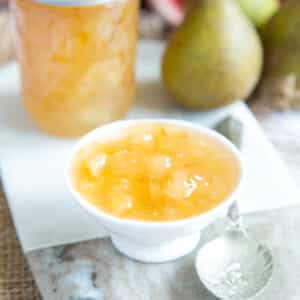
Easy Pear Jam Recipe
Delicately fragrant and absolutely delicious, this unusual pear jam recipe will win you endless compliments. You don't need to tell anyone that it was no trouble at all!
Servings: 45 portions
Ingredients
- 700 g pears - c. 520 g prepared weight
- 520 g white granulated sugar - equal to the prepared weight of fruit
- 2 tbsp fresh lemon juice
- a drop or two of vanilla extract or whole spices to taste - optional, exercise restraint!
Instructions
- Peel and core pears, discarding any damaged flesh. Chop into small pieces.700 g pears
- Put the chopped pear in a bowl and cover with the sugar. Add the lemon juice and any other ingredients, and stir well to combine.520 g white granulated sugar, 2 tbsp fresh lemon juice, a drop or two of vanilla extract or whole spices to taste
- Cover the bowl and leave for a few hours (preferably overnight). If the weather (or the kitchen) is warm, keep in the fridge.
- When you are ready to continue, put sterilized jam jars and lids in the oven to warm on a low heat. Remove any whole spices and put the fruit and sugar mixture into a deep pan over a low heat to dissolve the remaining sugar.
- Once the sugar has dissolved, turn up the heat. Bring the pear jam mixture up to a rolling boil until you reach setting point.
- Pour your jam into heated, sterilized jars. I find it easiest to do this by transferring the jam to a sterilized shatterproof jug and then pouring through a jam funnel.
- Seal with the lids. When the jars have cooled, check that the jars have sealed safely, and store in a cool, dark cupboard.
Notes
Adding spices to pear jam
- Spices – You can add a piece of cinnamon stick, a cardamom pod or two, a small piece of star anise or even cloves to the pear and sugar mixture. Don't overdo it. Remove the whole spices from the mixture before you start to cook.
- Vanilla – This is a classic combination with pears. If you want to add a little, use vanilla extract or bean paste. Avoid anything called vanilla essence, as this may be artificial and unpleasant. Vanilla extract can vary in intensity so go very carefully. For this quantity of pears, add half a teaspoon to the initial mix and taste the syrup before you boil to check whether you need more. Remember that boiling the jam reduces the volume and concentrates the flavours.
How to test for setting point
This is the only tricky bit of making jam: checking it’s hot enough to set, so that when cool, it will be jam rather than liquid. The temperature test. Digital jam thermometers are widely available, and not expensive. They are much easier to read than traditional jam thermometers. Heat the jam to the setting point (usually 105°C/221°F) and once your jam is there, you know it should be ready.Caution: Use temperature only as a guide. Once the thermometer reads 105°C, I give the jam a good stir to get rid of any hot spots and then test with the wrinkle test. It's OK for the temperature to go a couple of degrees higher – you can see that the pear jam has reached 106°C in the photo. The wrinkle test. Put a couple of side plates in the freezer before you start work. Once the jam is boiling, start testing by placing some on one of the plates. Allow it to cool on the plate. Then push your fingernail through the jam. If you see it wrinkle up ahead of your finger, it is ready. This technique takes a bit of practice. The flake test. Take a spoonful from the pan and turn it vertically to tip out the jam. If the jam runs off, it hasn’t set. If, however, some sticks to the spoon in a sort of wide drip that doesn’t fall, the jam is ready. Again, this works best with some practice. For more in-depth coverage, read my full guide to jam setting point.
Yield
This recipe yields about 720 ml (around 3 cups or 2 to 3 jars, depending on how big they are).Hints and tips
- Always make sure you use a deep enough pan when making jam. The ingredients should barely come half way up the sides when cold. The mixture will expand and rise up as it heats and you need to be able to keep it on the boil without it boiling over.
- Make sure that your jars are properly prepared for safe preserving. Read my article on how to sterilize jars for preserving if you are unsure.
- You can adjust this pear jam recipe to the quantity of fruit you have available, but if there is a lot of fruit, I would recommend making two smaller batches rather than one very large one. Small batch preserves are always better.
• Please note that the nutrition information provided below is approximate and meant as a guideline only.
• Unless stated otherwise cup conversions have been made with an online tool. For accuracy please check with your favoured conversion tool. We recommend buying inexpensive digital kitchen scales.
Calories: 51kcal | Carbohydrates: 13g | Protein: 0.04g | Fat: 0.1g | Saturated Fat: 0.003g | Polyunsaturated Fat: 0.01g | Monounsaturated Fat: 0.01g | Sodium: 0.2mg | Potassium: 14mg | Fiber: 0.4g | Sugar: 13g | Vitamin A: 3IU | Vitamin C: 1mg | Calcium: 1mg | Iron: 0.03mg