

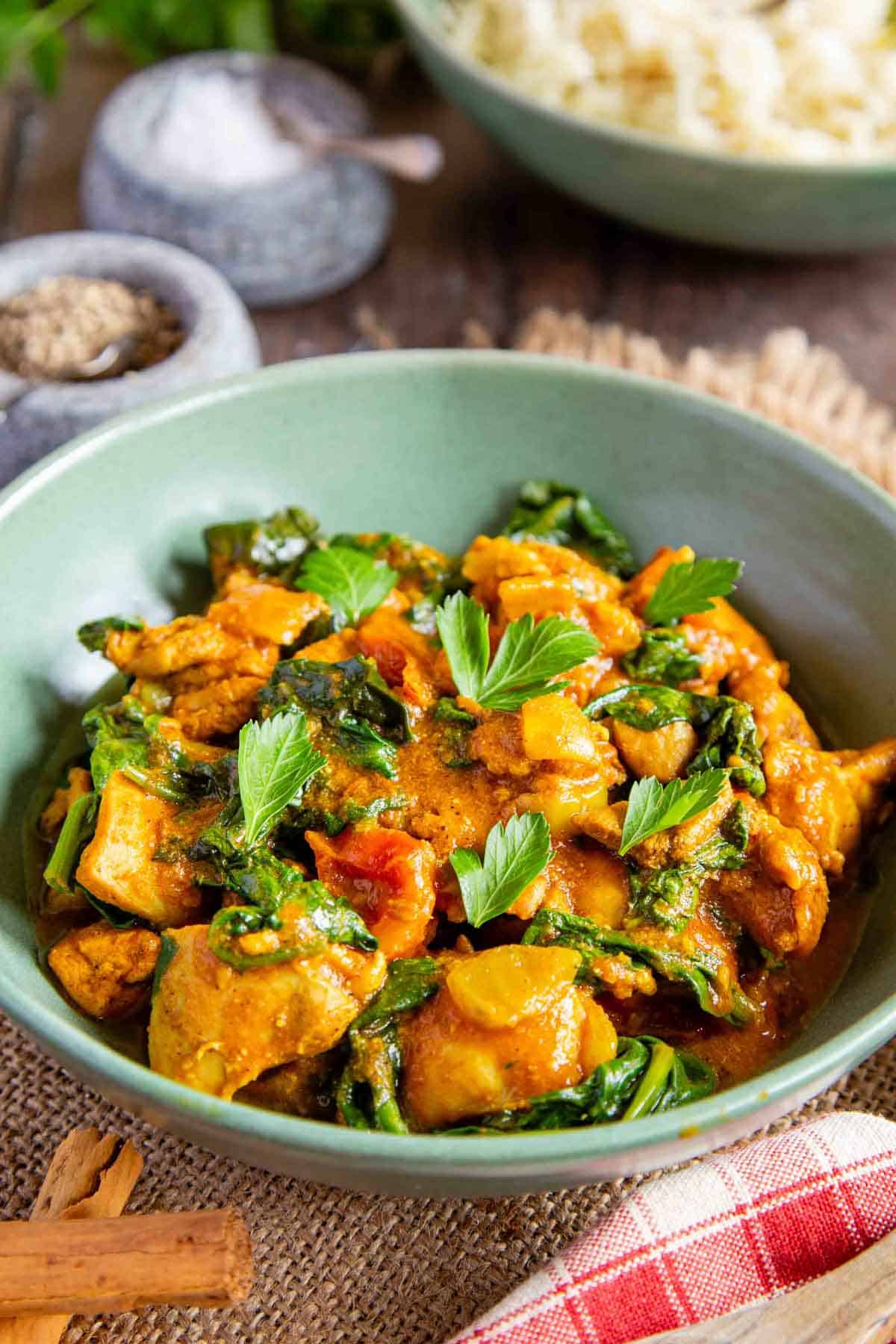
This vegetable packed chicken saag curry is fakeaway at its finest! A quick, easy and tasty take on the classic British Indian restaurant favourite. One pan with no need to make a base sauce in advance! Ideal for batch cooking and filling the freezer.
Chicken saag
In this chicken saag tender pieces of chicken are simmered with spinach, tomatoes, onions, garlic, ginger and warming spices to create a richly flavoured and deeply satisfying vegetable packed curry.
Although a classic saag is a milder curry, it is still flavour packed and, of course, you can easily adjust the heat to suit your taste.
In India, saag dishes can be made with a variety of green leaves, but here in the UK, spinach is the most common choice.
There are also lots of other saag dishes to enjoy, such as saag aloo (with potatoes) or saag paneer (with fresh cheese).
More curry house classics!
- When you want a generic old fashioned British style curry in a hurry try my quick chicken curry.
- Chicken Madras – Tender chicken, tomatoes, chillies and spices in a rich smooth sauce.
- A mild and creamy one pot with chicken in a creamy sauce thickened with almonds – chicken pasanda.
- Chicken jalfrezi has a rich tomato based sauce packed with spices, chilis, peppers, and onions.
- All my curry house recipes – never order in again.
Like most of my curry recipes this is a one-pot dish with no need for advance prep or a base sauce — keeping your curry-making easy and fuss-free.
Although I usually cook for two, I always make a big batch of curry. Cook once and eat twice (or more)! Most curries benefit from being made ahead — the flavours develop and meld beautifully after resting or a stint in the freezer.
With this recipe, there are also no awkward perishable leftover ingredients to worry about.
Why make easy chicken saag
- It is quick, easy and delicious – curry on the table in about half an hour!
- It is adaptable – use the spices and ingredients you have – make as hot or mild as you want
- No ultra-processed ingredients.
- It is far less fatty then restaurant take away dishes
- There’s no need to make a base sauce in advance,
- It’s great for batch cooking and for feeding a crowd or filling the freezer.
Easy chicken saag ingredients

- Chicken – Thighs are always my first choice when making a chicken curry or stew. They have more fat and thus more flavour, and they will not dry out when cooking. They are also cheaper than chicken breast.
This recipe uses filleted and diced thighs. You can either buy thighs ready filleted, or remove the skin and bone yourself. Pop both into a bag the freezer for the next time you make chicken stock. . - Onions – A single large brown onion or a handful of shallots.
- Spices – cumin, coriander, garam masala, cardamon and chilli powder – don’t worry if you are missing one of these – just add a little curry powder. If you want a hotter curry add a hotter chilli powder. Don’t simply add more chilli, as that will make the blend of spices unbalanced.
- Garlic and ginger pastes – or a combined one. If you don’t have these use a few cloves of garlic and a piece of grated fresh ginger root (leftover fresh ginger is best stored in a tub in the freezer – grate it from frozen the next time you use it).
Prepared garlic and ginger paste
This is central to easy Indian cooking at home, and a massive time saver.There are large jars available at my local Asian convenience store and it will keep well in the fridge. Depending on the shop you can buy a jar of mixed ginger and garlic, or individual jars of just the one ingredient.
If you don’t cook spicy food on a regular basis portion what’s left into an ice cube tray (I have a dedicated food ice cube tray), freeze and then pop out into a plastic bag or airtight container to store.
- Tomatoes – 2 medium tomatoes, or a handful of cherry tomatoes, chopped, or about a third of a tin of tomatoes.
- Spinach – raw spinach always looks like there will be far too much before you cook it, but then wilts down to barely anything. Pull off the thickest stalks and wash before use.
- Stock – a regular chicken stock cube.
- Ghee (or oil) not shown – I increasingly use homemade ghee for frying almost anything. A jar will last for ages in the fridge, adds a lovely nutty toasty flavour. If you don’t have ghee any flavourless oil will also work.
How to make quick chicken saag – step by step
Before you start, read my step-by-step instructions, with photos, hints and tips so you can make this easy chicken saag recipe perfectly every time.
Scroll down for the recipe card with quantities and more tips at the bottom of the page.

Step One – Peel and dice the onion.
Melt the ghee, or add the oil to a deep frying pan, skillet or casserole, add the onion and fry over a medium heat for for a few minutes until it is translucent and has some fragrance.
Get It Right! Helen’s Expert Tip
The size of your pan will make a difference to the outcome of the recipe. A 9″ / 23cm lidded frying pan is my go to for a one pot for two. A much larger pan will mean that everything will cook faster, and the sauce will dry out, a smaller pan will be too full, tricky to stir, and the sauce won’t reduce enough. However you don’t need the exact sized pan – between 8.5-10″ / 22-25 cm will do.
You want a pan that is fairly heavy, and non stick. I love a glass lid as you can see how everything is cooking without having to lift it. My pan is an everyday standard one from IKEA, which is both super affordable and replaceable.

Step Two – Add the spices and the ginger and garlic paste, stir and cook for another minute
Add the diced chicken thighs, stir to coat with the spices, and cook until they are no longer pink on the outside.

Step Three – Add the stock, tomatoes and tomato puree, stir it all in.
Bring to a gentle simmer, cover with the lid ajar, or use a splatter guard to allow the steam to escape and the curry to reduce, whilst not making too much of a mess of your stove top.
Let the curry cook for about 20 minutes, stirring from time to time, until it is reduced and thickened.

Step Four – Now add the spinach leaves, removing any bulkier stems. Just place them on top of the sauce, there no need to stir it in at this stage. Cover and let everything gently simmer for another two minutes or so until the spinach wilts.
If you want to repeat the process with more spinach, you will be surprised at how much you can add, as it wilts to almost nothing

Step Five – stir the spinach in, taste and season if needed.
If the curry needs to be thickened mix a teaspoonful or two of cornflour/cornstarch in a small bowl with the same volume of sauce from the curry to form a “slurry”, before stirring it back into the curry gently cooking until it thickens.
When thickening with cornflour always make the paste / slurry in a separate bowl never add the cornflour directly to the hot curry – you will never get the lumps out.
- Read more in my ultimate guide on how to thicken with cornflour.
Serving suggestion
I like to garnish the dish before serving with some thinly sliced chillis or coriander leaves.
Serve the chicken curry with traditional British Indian restaurant side dishes, such as pilau rice or cumin rice. Flatbreads such as rotis, parathas or naan are other options. A bowl of creamy home made raita helps reduce the heat!
Variations
- Use leftover roast chicken – fry the onions and spices, and then add the cooked chicken along with the rest of the ingredients. You may find you will need some extra liquid.
- Add extra vegetables – you can make this curry go far further buy adding some extra vegetables, or pulses.
Fry sliced peppers or mushrooms along with the onions.
Or add a can of any type of bean or pulse – rinse and add – chickpeas would work very well.
- Adjust the spicing and heat to taste, use a hotter chilli power for a hotter curry.

Storage
This chicken saag, like most curries, is far better when made in advance and allowed to rest, then reheated before serving. This gives more time for the flavours to infuse into the meat, and for everything to meld and soften.
Fridge – Allow to cool, and as soon as it is room temperature pack into an airtight container and place in the fridge. It keeps in the fridge for up to 3 days.
Freezer – Cool and pack into an airtight container. Store in the freezer for up to 3 months. Defrost in the fridge or on the worktop before reheating.
Reheat in a pan on the stove top, or in the microwave, making sure it is properly hot all the way through before serving.
Hints and tips
- Take time to fry the chicken then the onions and spices property for maximum flavour.
- Curries lend themselves very well to batch cooking and it is easy to double this recipe up.
Generally when doubling a recipe you don’t always need to double the liquid, so don’t double the amount of stock that you add.
- I don’t recommend halving this recipe – the spice quantities become fiddly and a smaller batch is more likely to dry out.
The curry freezes and reheats so well it is the perfect dish to cook once and eat twice or more.
FAQs
This is a mild to medium curry, but you can easily adjust the level of spice. For a hotter dish, you can use a hotter chilli powder. Don’t be tempted to simply add more chilli powder, as too much will unbalance the spice blend.
Yes, absolutely. You may find you need a little more liquid. The chicken obviously won’t need frying before adding the other ingredients.
I’m increasingly using ghee in lots of my cooking. It’s easy to make at home if you can’t find it locally. I love the rich, slightly nutty flavour. But if you don’t have any, then oil is absolutely fine.
More British Indian restaurant recipes
- My slow cooker beef curry is a tasty and easy recipe that’s ready when you get home
- Chicken bhuna – tender chicken in a rich spiced tomato onion sauce.
- Chicken dhansak is a delicious lentil based curry with sweet and sour notes in a fruity, subtly spiced sauce.

Chicken Saag
Ingredients
- 1 tbsp ghee or cooking oil
- 1 onion
- 500 g chicken thighs (Skinned and diced
1)
- ½ cup chicken stock
- 1 tbsp tomato puree
- 100 g tomatoes (2)
- 100 g spinach
Spices
- 2 tsp garlic paste (3)
- 2 tsp ginger paste (3)
- 2 tsp garam masala
- 1 tsp turmeric
- 1 tsp ground coriander
- 1/2 tsp ground cumin
- 1/2 tsp chilli powder
Instructions
- Fry the onion – Peel and dice the onion. Melt the ghee, or add the oil to a 9"/23cm deep frying pan which has a lid. Add the onion and fry over a medium heat for for a few minutes until it is translucent and has some fragrance.1 tbsp ghee or cooking oil, 1 onion
- Add the spices – Add the garlic, ginger paste, and spices. Stir and cook for another minute or so.2 tsp garlic paste, 2 tsp ginger paste, 2 tsp garam masala, 1 tsp turmeric, 1 tsp ground coriander, 1/2 tsp ground cumin, 1/2 tsp chilli powder
- Add the chicken – Add the diced chicken thighs, stir to coat with the spices, and cook until they are no longer pink on the outside.500 g chicken thighs
- Add liquid – Add stock, tomato puree and tomatoes – stir and cover½ cup chicken stock, 100 g tomatoes, 1 tbsp tomato puree
- Simmer – Bring to a gentle simmer, cover with the lid ajar, or use a splatter guard to allow the steam to escape and the curry to reduce, whilst not making too much of a mess of your stove top.Let the curry cook for about 20 minutes, stirring from time to time, until it is reduced and thickened.
- Spinach – Now add the spinach leaves, removing any bulkier stems. Just place them on top of the sauce, there no need to stir it in at this stage. Cover and let everything gently simmer for another two minutes until the spinach wilts. If you want to repeat the process with more spinach, you will be surprised at how much you can add, as it wilts to almost nothing100 g spinach
- Thicken – stir the cooked spinach through, taste and season if needed.If the curry needs to be thickened mix a teaspoonful or two of cornflour/cornstarch in a small bowl with the same volume of sauce from the curry to form a “slurry”, before stirring it back into the curry gently cooking until it thickens.When thickening with cornflour always make the paste / slurry in a separate bowl never add the cornflour directly to the hot curry – you will never get the lumps out.
- Serve – Serve the chicken curry with traditional British Indian restaurant side dishes, such as pilau rice or cumin rice. Flatbreads such as rotis, parathas or naan are other options. A bowl of creamy home made raita helps reduce the heat!
Notes
- Chicken Thighs are always my first choice for chicken pieces. Because they have more fat they have more flavour and are also cheaper than chicken breast. You can also use chicken breast.
This recipe uses filleted and diced thighs. You can either buy thighs ready filleted, or remove the skin and bone yourself. Pop both into a bag the freezer for the next time you make chicken stock. - Tomatoes – about 100g, or what you have. This recipe is very forgiving. 2 medium or a handful of cherry tomatoes.
- Prepared garlic and ginger paste – This is central to easy Indian cooking at home, and a massive time saver. Depending where you buy you can buy a jar of mixed ginger and garlic, or individual jars of just the one ingredient. Leftovers can be portioned into an ice cube tray and frozen.
If you do not have them then use 3 cloves garlic and a 1 inch piece of ginger root. the rest of the ginger root can be stored in a tub in the freezer. - Spices – the base flavour of this curry is from the blend of spices; if you are missing one of these then just add a little curry powder. For a hotter curry use a hotter chilli powder rather than simply add more as that will unbalance the mixture.
- Use leftover roast chicken – fry the onions and spices, and then add the cooked chicken along with the canned tomatoes, coconut milk and stock.
- Add extra vegetables – you can make this curry go far further buy adding some extra vegetables, or pulses. Fry sliced peppers or mushrooms along with the onions, add a bag of spinach at the end of cooking (add on top of the curry, pop the lid on and leave to wilt for a minute, stir in and repeat if needed). Or add a can of any type of bean or pulse – rinse and add – chickpeas would work very well.
- Adjust the spicing and heat to taste.
- Take time to fry the spices and chicken properly, so that they are fragrant and the chicken is thoroughly cooked on the outside and well covered in the spice mixture.
- Curries lend themselves very well to batch cooking and it is easy to double this recipe up, BUT if you do so don’t double the stock.
- I don’t recommend halving this recipe – the spice quantities become fiddly and a smaller batch is more likely to dry out. It freezes and reheats so well it is the perfect dish to cook once and eat twice.


Leave a Reply