

Salmorejo is a Spanish cold tomato soup, thickened with bread, which is delicious, quick, easy to make using very few ingredients.
Similar to gazpacho it will become your new favourite summer soup! Its commonly served garnished with Iberico ham and diced boiled egg.

Salmorejo Recipe
I think that soup is something you can never get bored of; with nearly infinite possibilities, of flavour, texture and temperature.
Salmorejo, is a cold tomato soup, thick, garlicky, dairy free but creamy (the creaminess come from the bread and olive oil) and so so delicious.
It is similar to Pappa al Pomodoro, made from a base of blended tomatoes and bread, but unlike the Italian version it is not cooked and it is served cold.
It is classic peasant food; which always tastes far greater than the sum of its parts. A batch of salmorejo will use up overripe tomatoes and yesterday’s bread, flavoured with garlic, sherry vinegar and olive oil, making the most of simple local ingredients, and cutting down on food waste.
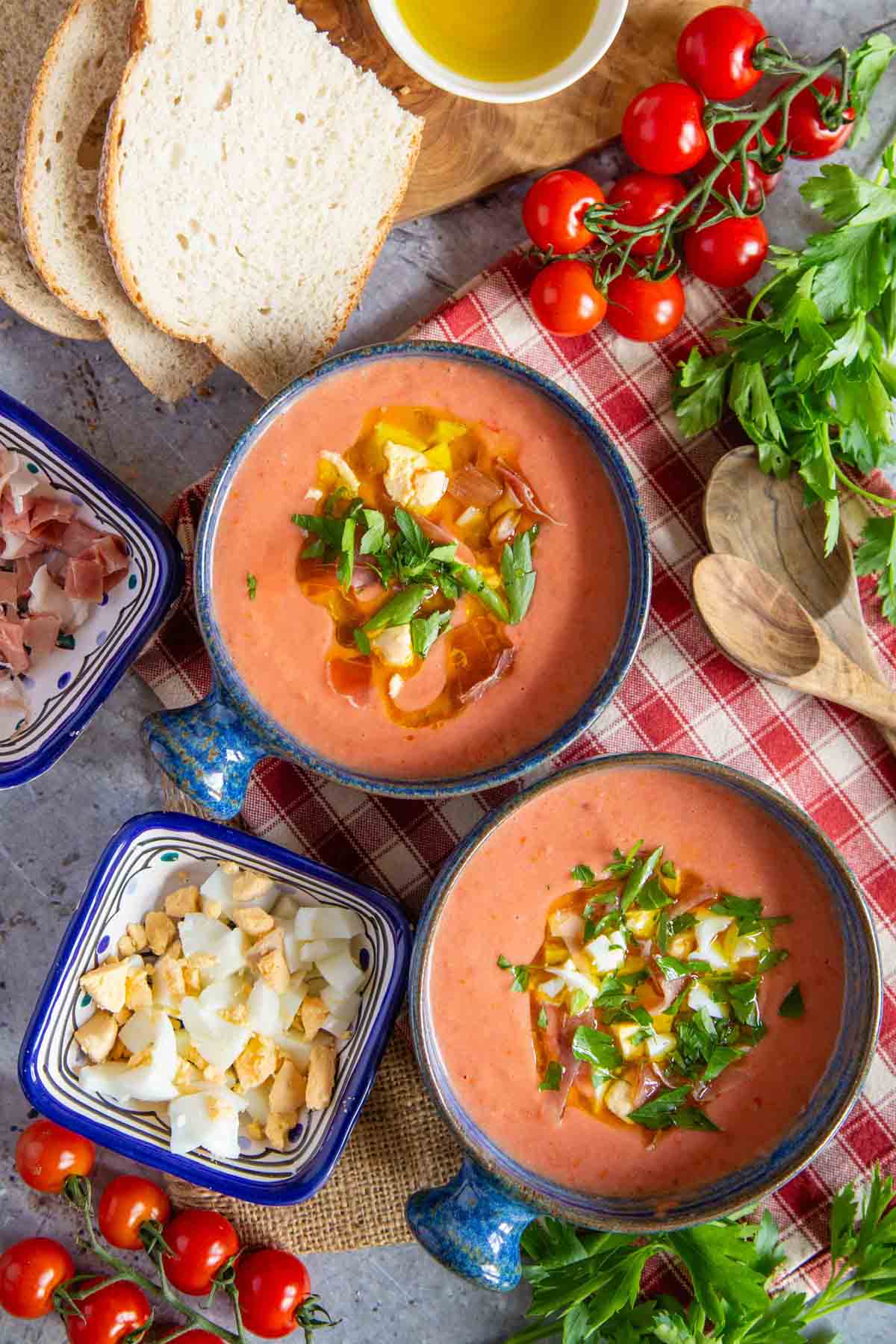
Salmorejo will often be served plain as it is, as a dipping sauce – I have had it with grilled fish, or with a garnish of chopped hard boiled eggs and Spanish ham turning it into a complete meal.
It is so easy to make, needing just a stick blender to whizz it up, although you can of course make it in a food processor or blender.
See also
- Gazpacho – the better known Spanish cold tomato and vegetable soup
- Got leftover salad? Turn it into a refreshing salad soup
- All my soup recipes in one place!
Salemorejo – A Córdoban Classic

Salmorejo originated in Cordoba in Andalusia; where it is on the menu of every bar, restaurant and taberna in the city. I had one or two bowls a day when I visited, it is always refreshing, but of course there are as many versions, and garnishes, as there are chefs and cooks in the city.
I love trying new dishes when I travel, and bringing them home recreating them in my kitchen until they are just right for us!
What is Salmorejo?
Thanks to Spain’s hot summer weather there are many Spanish cold soup recipes – most famously gazpacho and all its many variations. but I think my favourite is probably salmorejo.
Salmorejo is a far simpler recipe than gazpacho, it doesn’t use peppers and cucumber, just five basic ingredients – tomatoes, bread, garlic, extra virgin olive oil and sherry vinegar.
It is thicker and creamier than gazpacho, and will always be served in a bowl, made into a meal topped with different garnishes – usually a chopped hard boiled egg and Spanish ham.
Why make Salmorejo
- It is a super easy recipe with minimal ingredients and equipment
- It makes a refreshing soup – that is easy enough for every day but can be dressed up or a dinner party.
- One bowl gives you several of your 5 or more portions of vegetables a day.
- It is a classic no waste recipe – using up overripe tomatoes, and yesterdays bread!
Salmorejo ingredients

- Tomatoes – these are central to the dish, so you want the best. Ideally vine ripened, as ripe as can be, a selection of different types of tomato, and preferably having never been in the fridge as this robs them of all their flavour.
You can also use yellow and orange tomatoes.
Helen’s Pro Tip
If you buy tomatoes in the store they would have almost certainly been chilled, just store them on the worktop – lots of the flavour will come back after 24 hours.
- Bread – a good rustic style bread with some structure and taste. Ideally white, and without seeds to make the blending easier. You do not want cheap supermarket sliced white bread. See my substitution notes.
- Olive Oil – a strongly flavoured extra virgin olive oil, one from Andalusia would be ideal.
- Sherry Vinegar – adds acidity to balance the flavour, and to act as a flavour enhancer. Any white vinegar with some flavour but not too much acidity would work here, as well as a fruity apple cider vinegar.
Sherry Vinegar
Sherry vinegar is barrel aged and is richer and more complex and nutty – almost caramelly – than a red or white wine vinegar, as well as being less acidic. If you substitute go easy on the quantities, as it is easy to overwhelm the soup.
- Garlic – one of two cloves to taste, I do not like too much raw garlic so always tend to use less.
- Sea Salt – good salt for flavour
How to make Salmorejo – step by step
Before you start, read my step-by-step instructions, with photos, hints and tips so you can make this salmorejo perfectly every time.
Scroll down for the recipe card with quantities and more tips at the bottom of the page.

Step One – Roughly chop the tomatoes (there is no need to peel), peel and chop the garlic and cube the bread – if the crusts are especially hard you can remove them. Add to a bowl, pour over the water and sprinkle in the salt.

Step Two – use a stick blender to blitz to a smooth liquid. You may think that it will never mix, but keep going, I find you need to lift the blender and put it back into the bowl and whizz again, in a “dabbing” motion. Everything will suddenly come together.
Keep whizzing until you have a smooth liquid. My stick blender easily blends the tomato seeds and crusts (I removed them in the photographed batch). Alternatively you can use a food processor or jug blender.
Once mixed and completely smooth slowly pour in the olive oil, gently whizzing all the time to form an emulsion; as you do this the soup will pale and slightly change colour, and develop the characteristic creamy texture.
Helen’s Pro Tip
Mix in the olive oil slowly and gently as it is easy to bruise it which will make it taste bitter.
Check the seasoning and add a little more salt or vinegar to taste, but remember that the flavours will change, develop and meld with time.
Cover and chill the soup in the fridge for at least an hour before serving, to allow the flavours to develop and meld. Adjust the seasoning if needed.
Serving suggestion
Traditionally salmorejo is served with a garnish of chopped hard boiled egg and some Spanish ham. I like to add a swirl of olive oil and some chopped herbs and have bowls of extra garnish.
Variations
- Canned tomatoes – the purists would be horrified, but you can substitute about half the fresh tomatoes with a can of good quality canned tomatoes for a budget option, without compromising the flavour too much.
- Garlic – the flavours develop with time after the soup has been made – do not be tempted to throw in extra cloves of garlic.
- Bread – Depending on the power of your blender, and how smooth you would like the finished soup to be you do not need to remove the crusts from a rustic white loaf. Cube the bread and place it in a bowl, add the other ingredients on top and let them soak in and soften the bread.
I have also made this with a seeded rye based sourdough, which does work, but you can clearly taste the bread, so it might not be to everyone’s taste.
- Make this your own with the garnishes – chopped hard boiled egg, ham, a dollop of allioli, chopped herbs, and a drizzle of olive oil, you could also use a few roasted chickpeas, or sprinkle over some seeds for a vegetarian version.
Storage
Fridge – Keep in a covered container in the fridge for up to 3 days. I remove from the fridge about half an hour before serving, so it is cool, somewhere between fridge and room temperature to serve.
Freezer – Pack into freezer containers and freeze. Allow to defrost and serve. Depending how smoothly blended the soup is it might separate do give it a good stir before serving. When I tested I was astonished that this froze so well.
Hints and tips
- Tomatoes – these are the most important part of the dish – ideally use vine ripened tomatoes. If you have bought tomatoes do not put them in the fridge before you make the soup.
- You do not need anything more than a stick blender to make this, although you can of course make it in a jug blender, or food processor. Add the bread to the bowl first, then the other ingredients so they soak in and soften the bread. People have been making salmorejo before anyone had electric kitchen gadgets!
- Go easy on the garlic – the flavours intensify after a few hours in the fridge.
FAQs
Gazpacho has other vegetables, typically peppers and cucumber, beside the tomatoes, and is not thickened with bread.
Absolutely yes! let it defrost and give a good stir before serving.
I’ve seen several ways – but I usually say “sahl. – moh. – reh. – hoh”
You may also like
- Roast tomato soup – also good served cold!
- Watercress soup is another delicious summer soup
- All my tomato soup recipes

Salmorejo (Spanish Cold Tomato Soup)
Equipment
- Stick / Immersion Blender (UK) Get one with the highest wattage you can, and ideally a steel shaft
Ingredients
- 1 kg (2.2 lbs) vine ripened tomatoes (roughly chopped)
- 200 g (8 oz) rustic white bread (cut into cubes)
- 1 garlic clove (peeled)
- 1 tsp sherry vinegar
- 4 tbs extra virgin olive oil
- salt (to taste)
To garnish
- 2 hard boiled eggs (peeled and chopped)
- 4 slices Serrano Ham (or other air dried ham)
Instructions
- Mix & Blend – Blend the tomatoes, bread, garlic, and vinegar with about 120ml of water until you have a smooth, thick puree. You can use a stick blender to do this. If you think that your stick blender is not powerful enough then layer all the ingredients into the bowl and leave for half an hour for the bread to soften. You may need to add a little more water depending on the ripeness of the tomatoes. Blitz really well at this stage until smooth1 kg vine ripened tomatoes, 200 g rustic white bread, 1 garlic clove, 1 tsp sherry vinegar
- Add the oil – Slowly drizzle in the olive oil into the tomato mix and slowly blend it in. As the oil emulsifies with the soup it will turn a deep salmon pink, and develop an almost creamy texture. Over blending at this stage will bruise the olive oil and make it taste bitter, so blend it in slowly.4 tbs extra virgin olive oil, salt
- Chill – Cover, and chill for at least 30 minutes before serving. The flavour will develop with time so if you can, leave it for a couple of hours.
- Garnish & Serve – Serve with a garnish of chopped boiled eggs, Serrano ham and an extra drizzle of olive oil.2 hard boiled eggs, 4 slices Serrano Ham
Notes
Video


Helen Best-Shaw
I’ve been making this on repeat every summer. I’ve only recently learnt that you can bruise the olive oil by over whizzing it, which can make it taste bitter. Which explains why some batches were so much better than others.